For elective clinics
More qualified patients. Not just more leads.
Vertex runs the acquisition, answers what comes in, and gets the consultation booked and attended. Then it shows what the clinic collected, and which part of the work paid for itself.
A real person at Vertex reviews your clinic.
The patient journey
- Find Someone discovers the clinic
- Enquiry They ask about treatment
- Booking They choose a time
- Patient They attend for treatment
- Revenue The clinic gets paid
Vertex fact
Working with 50+ clinics
No clinic's results are published on this page, and no figure appears on it without saying where it came from.
01The problem
Most clinics lose patients in the gaps.
The ad account, inbox, diary and payment system each see one part of the journey. When those parts do not connect, enquiries get missed and nobody can see what actually turned into revenue.
-
Advertising and website Discover Someone finds the clinic
The reply comes too late
-
Inbox and phone Enquiry They get in touch
Nobody follows up
-
Booking diary Booking They choose a time
The appointment is missed
-
The clinic Appointment They attend
Nobody knows which ad worked
-
Payment system Payment The clinic gets paid
Some people will decide not to go ahead, and some will not be suitable for treatment. That is a clinician's decision. A reply that came too late is not.
Nothing above tells you which one is yours. That is the point. Vertex measures the journey first and fixes the break that is costing the most, rather than assuming the clinic needs more advertising.
02The evidence
The loss is measured.
Three published findings on what a slow reply and a missed appointment cost. None of these is a Vertex result, and none of them is a clinic's.
-
Nearly 7 times
as likely to qualify a web lead when the reply goes out inside an hour, rather than an hour later.
Public research Harvard Business Review, The Short Life of Online Sales Leads, 2011. Web leads, across industries, and not a clinic benchmark.
-
23 in 100
appointments missed on average across 105 healthcare studies, which is the review's own overall no show rate.
Public research No shows in appointment scheduling, a systematic literature review, 2018. Across healthcare studies, not a private clinic.
-
15 in 100
the no show rate where clinics sent appointment reminders by text, against 21 in 100 where they did not.
Public research BMJ Open, Using digital notifications to improve attendance in clinic, 2016. A meta analysis of 21 studies in healthcare settings.
Which of these is costing your clinic is the question Vertex answers first, before it recommends anything.
03How it works
Five stages. One line.
Vertex connects finding patients, following them up, running the clinic and seeing what came back as revenue.
-
Audit
Find what is leaking
Decides the rest
-
Acquire
Bring the right people in
-
Convert
Reply, follow up and get them booked
-
Operate
Run the diary and patient journey
-
Prove
See what actually made money
Audit comes first because it decides what the other four should be. If the leak is in follow up, more advertising only sends more enquiries into it.
04The work
What Vertex actually does
Each stage, and what it looks like when Vertex runs it.
Audit Find what is leaking
- Website
- Search
- AI search
- Reviews
- Competitors
- Ad account
Six signals scanned. Two are leaking, one is already working.
Acquire Bring the right people in
Three pieces of work that go out for a clinic.
Convert Reply, follow up and get them booked
Three enquiries clamped into one booking.
Operate Run the diary and patient journey
The day, one appointment attended, one next step.
Prove See what actually made money
One trail survives to the patient. Two break.
The work behind it
What we make people see
Six things we make and run for a clinic. Each one has one job in the same journey, and six of them are still one system.
-

GoogleAds
In front of people already searching
-

LandingPages
A clear reason to enquire
-

EducationalContent
Understanding before the decision
-

PerformanceCreative
The thing that stops the scroll
-
PaidSocial
In front of people who were not searching
-
BrandingDesign
A clinic that looks considered
Everything above is made for one clinic and stays with it. The pages, the film and the brand are the clinic's own, and the people they bring in arrive at the clinic rather than being passed across from somebody else's list.
The system underneath
What the service runs on.
The ads, the pages and the film are what a clinic sees. The commercial journey runs underneath them, on Vertex's own system.
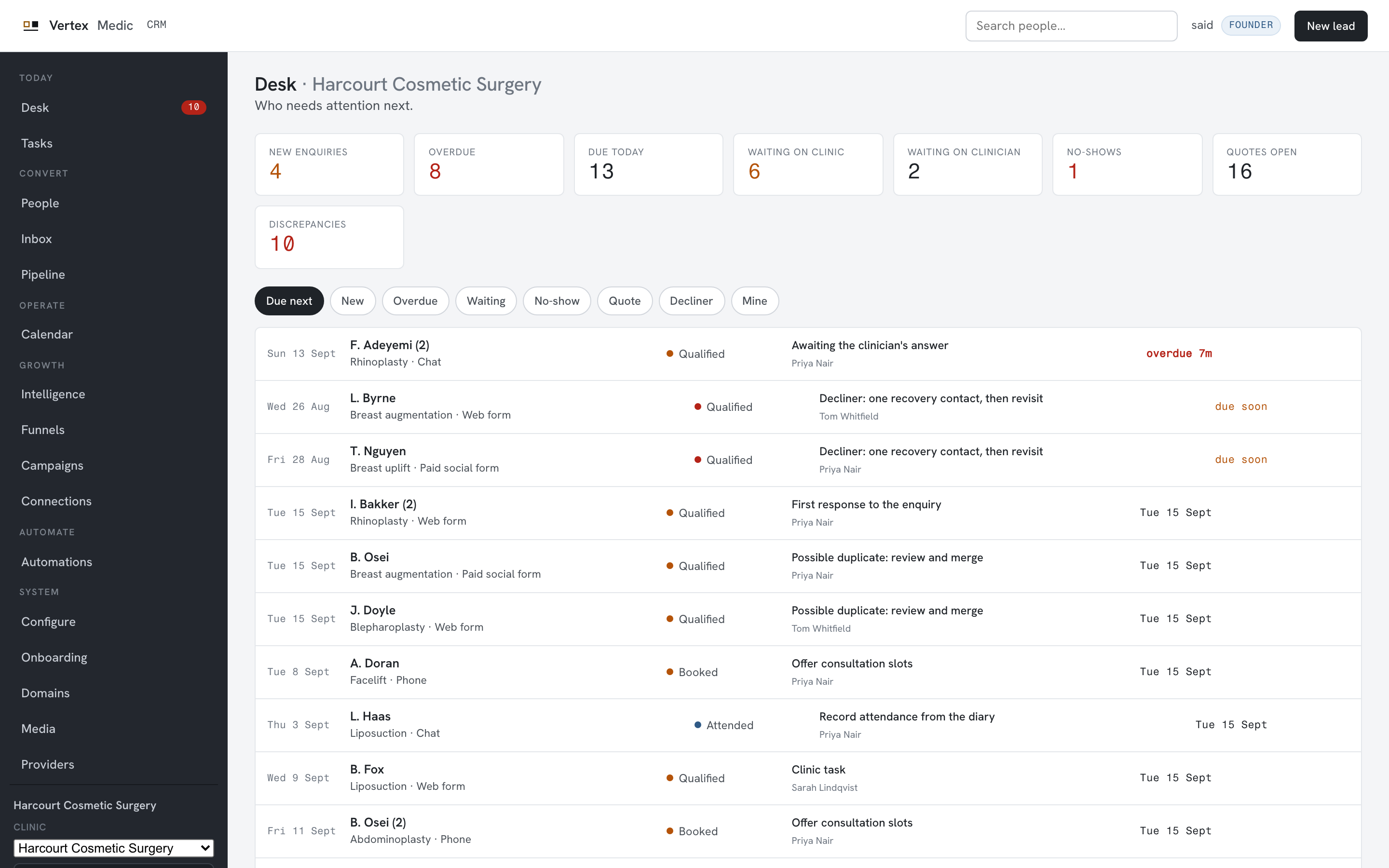
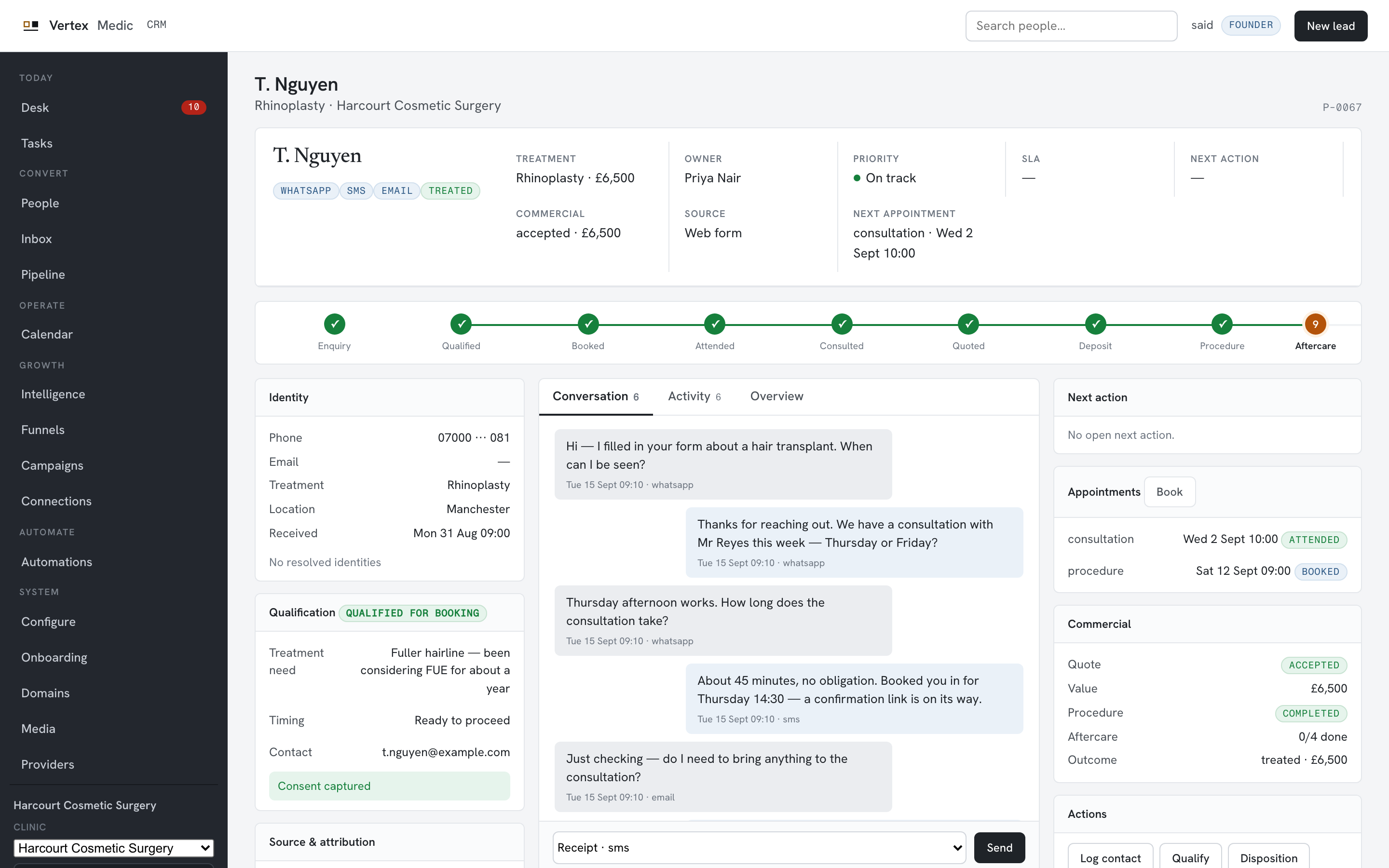
Demonstration data The real Vertex screens, run against an invented clinic. No clinic's results appear anywhere on this site.
-
Every open enquiry has an owner.
One owner, one next action, and a time it is due. Overdue is a state on the screen, not something somebody has to remember. Clinical questions go to a clinician, not here.
-
One person, one record.
One person, from the enquiry through booking, attendance, the deposit, the treatment and the aftercare, with attendance taken from the clinic's own diary. The call, the messages and the emails stay on that record, so whoever picks it up next is not starting again, and where two of them disagree both are kept and the disagreement is shown. Anything clinical is recorded as the clinic's own words, never as a conclusion of ours.
-
Every number keeps its source.
Spend and clicks come from the advertising platform. The enquiry through to the collected revenue is recorded in Vertex. The ratios are worked out from those facts, and the attribution model is named as a model.
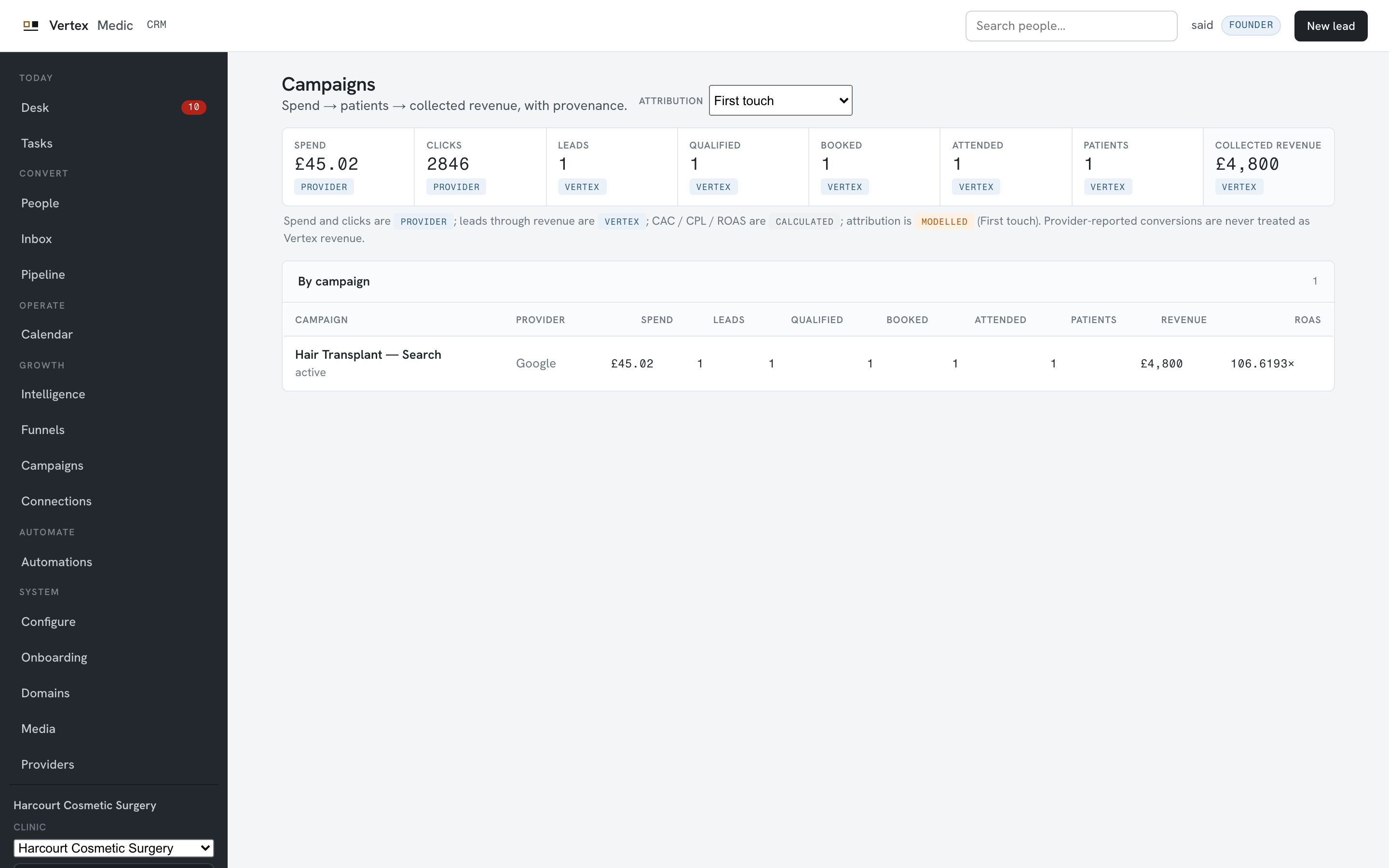
Every figure on the revenue line carries one of four labels. The labels are the product's own, and they are the same four wherever a clinic reads them.
- Recorded
- Read from the source itself, and the source is named.
- Verified
- Recorded, and the clinic's own diary agrees with it.
- Calculated
- Worked out from recorded figures, with those figures named.
- Modelled
- An assumption. Labelled as one, and never presented as a fact.
Every number tells you where it came from. That is the difference between a figure and evidence.
05The transformation
The clinic stops working in pieces.
The website, the enquiries, the diary, the appointments and the money usually live in five different places.
Five parts of a clinic operation, shown apart and then joined. The first small figure is a seam with the parts apart, and the pink gap between them. The second is the same seam joined, and the lime line across it is the join.
Five jobs, one place. Vertex joins them up, so a clinic can see and run all of it together.
06Why Vertex
Each supplier owns one part. Vertex answers for the whole.
Four suppliers each see one part of the journey. The joins between those parts belong to nobody. Vertex takes the whole journey on as one job.
One frame drawn around four things a clinic already has, listed down the page on a phone and across it on a wide screen: the agency, reception, the diary and the payment system. Each one stands on a short rule of its own, which is the only part of the journey it can see. Under them is a pink mark and the sentence nobody owns the joins between them. A single Vertex plate sits on the frame's edge, meaning Vertex answers for the whole journey those four parts add up to.
- The agency sees the advertising
- Reception sees the enquiries
- The diary sees the appointments
- The payment system sees the money
Nobody owns the joins between them.
Vertexthe whole journey
One team, one scope, one set of numbers. An agency brought in for leads is judged on leads. Vertex took on the whole journey, so it answers for what the clinic collected.
The same month, reported two ways
Reporting that stops at the lead
- Clicks
- Leads
- Cost per lead
Reporting that reaches the money
- Source and campaign
- Enquiry
- Consultation booked
- Attended
- Treatment
- Collected revenue
Both are honest about what they can see. The first stops at the lead because the lead is where its access to the clinic's day stops, and the part of the month underneath it belongs to somebody else's report.
A team runs the journey.
Vertex is a managed commercial layer. The system carries the workflow, the ownership and the evidence, and people at Vertex add oversight where judgement is needed.
The clinic's systems stay the clinic's.
The diary stays where it is. Appointments and attendance come from the system the clinic already uses, and Vertex works against it rather than asking a clinic to move first.
The clinic's decisions stay the clinic's.
Capacity, the treatment plan and every clinical judgement stay with the clinic. No commercial role at Vertex can take a decision that belongs to a clinic.
Clinical judgement stays clinical. The commercial journey is the part Vertex takes on, and answers for.
07How it starts
Someone at Vertex reads your clinic.
It starts with the website and four quick answers. Everything after that is done by a person, not a score.
A page with three entries on it, read in order down the margin. A mark appears against each entry as it is read, and the third mark is lime, meaning the place to start.
-
You send us the clinic.
The website, and four quick answers about how the clinic runs.
-
A person goes through it.
Not a score, and not an automated report. Someone reads all five things below by hand, then the ad account, where the line leaks between what went out and what came back.
-
You get back what they found.
What is working, what is leaking, and where we would start. If nothing is worth acting on, we say that too.
What the review covers
- How the clinic reads to someone searching for it
- What the reviews say, and how many there are
- Whether an AI assistant answers for the clinic, and what it says
- How the clinics nearby compare
- Where the ad spend stops turning into enquiries
There are no testimonials on this page and no clinic logos. Where a figure appears on this page and it is not ours, it says whose it is.
Clinical questions go to a clinician, not the desk.
08The first piece of work
The Proof Sprint. Fixed scope, fixed fee.
The review says where the journey is leaking. The sprint is the bounded work that answers it, on the part of the journey the review found is the constraint. It runs to a signed statement on day 45, and handover or exit completes by day 50.
-
Days 1 to 3
The data comes in
Exports, call records and the diary, and what is asked for and what is refused.
-
Days 4 to 7
The measurement is repaired
Call attribution and form events, so a reply can be timed and an enquiry can be traced to the thing that produced it.
-
Days 8 to 14
Six months are reconciled
Every enquiry matched to what happened to it, and the ones that cannot be matched named rather than estimated.
-
Days 15 to 20
The desk is set up
Templates, owners, the time every reply is due, and the route a clinical question takes. Every word a patient will read is approved by a named person first.
-
Day 15
The holdout is sealed
One wave is held back at random and never touched again, so the difference at the end can be claimed rather than modelled.
-
Days 21 to 45
Two waves run
The clinic's real enquiries, answered and followed up as they arrive, in two measured waves.
-
Days 35 to 45
The capacity map, then the statement
Whether the diary can hold what the work brings, and a signed statement of what was recorded, what moved and what did not.
-
Days 46 to 50
Handover, or exit
Either the desk carries on as the standing relationship, or the clinic takes the findings and stops there.
What the sprint needs
- The clinic's own data can be read: exports, call records and the diary.
- Someone at the clinic can approve a template, and a clinician is named to answer clinical questions.
- The diary has room for the demand the work brings.
- The holdout is accepted: one wave measured against another, and left alone.
What the clinic ends up with
- Six months of enquiries reconciled, including the ones that could not be.
- Two waves run live, with a sealed holdout measuring the difference between them.
- A capacity map: what the clinic can hold, and what it would need to hold more.
- A signed statement, and a recommendation that is allowed to be no go.
The fee is fixed before day one: never a share of the media spend, and never a fee per patient. What counts as the outcome is not the same in every clinic. In procedural care it is usually a consultation that was attended, and where treatment is booked rather than consulted for it is a booking, often one a deposit is holding. Underneath all of them is the figure that is the same everywhere: what the clinic collected. You keep the review and the findings whatever you decide, and a statement that says no go is a result rather than a failure.
09Who this is for
Is this the kind of problem you have?
Four situations this is built for. If none of them is yours, you have your answer.
-
Enquiries arrive by more than one route.
A form, a phone call, a chat window, a message. Each one needs a reply.
-
More than one person answers them.
Reception, a manager, an agency, or whoever is free at the time.
-
The work carries on long after the enquiry.
A quote, a date in the diary, a follow up, the appointment, the payment.
-
Someone at the clinic can change how this works.
An owner or a manager who can act on what comes back.
The same journey turns up in hair restoration, cosmetic surgery, aesthetics and skin, dentistry, physiotherapy and private diagnostics. The clinic differs; the commercial path underneath it does not.
That is the problem Vertex is built for.
10Get your clinic analysed
Tell us about your clinic.
The website, the clinic's shape, and who to reply to. That is the whole request.
Nothing is charged and nothing is scheduled.
Three parts: your clinic, four quick questions, and your details.